


 Eng
Eng 
 عربى
عربى
 Home / News / Industry News / How thin is too thin for extra-thin resin cutting discs to stay safe and precise
 How thin is too thin for extra-thin resin cutting discs to stay safe and precise
 2026.07.03
 Industry News
Ultra-thin abrasive wheels are widely used in fabrication and maintenance work because they reduce cutting resistance and improve edge quality. Yet the reduction in thickness also shifts the safety margin closer to its operational limit. The balance between cutting speed, stability, and fracture risk becomes increasingly sensitive as disc thickness drops.
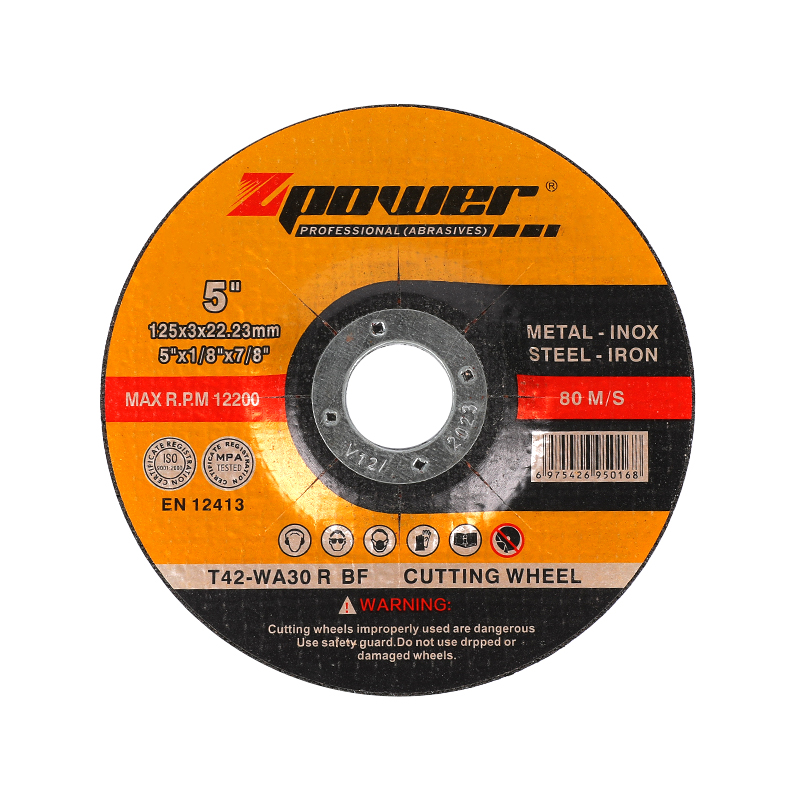
An Extra-Thin Resin Cutting Disc typically falls within a thickness range of about 0.8 mm to 1.2 mm, with some specialized variants reaching slightly below 0.8 mm depending on reinforcement structure and bonding strength.
Thickness boundary and mechanical stability
- Below 0.8 mm: structural rigidity decreases sharply, side-load tolerance becomes extremely limited.
- 0.8–1.0 mm: widely used range balancing speed and safety in standard angle grinders.
- Above 1.2 mm: stability improves, cutting speed slightly reduces, heat control becomes more predictable.
Industry data indicates cut-off wheels are generally manufactured between 0.2 mm and 3.0 mm, but operational safety for handheld grinders is concentrated in the thin segment above ~0.8 mm due to bonding reliability and reinforcement.
Speed behavior versus disc thinning
Reduced thickness changes the interaction between abrasive grains and workpiece. Less material contact lowers cutting resistance, yet also increases sensitivity to vibration.
- Kerf reduction: thinner discs remove less material per pass, improving cut smoothness.
- RPM sensitivity: most 115 mm discs operate around 13,000 rpm, requiring strict adherence to rated speed limits.
- Thermal load: reduced contact area lowers heat accumulation but increases localized stress points.
Critical safety threshold zones
Safety limits are not defined only by thickness; reinforcement structure and fiber mesh play a decisive role. However, practical workshop experience shows clear operational thresholds.
- 0.6 mm and below: requires extremely controlled feed pressure; unsuitable for general handheld use.
- 0.8 mm class: considered standard ultra-thin configuration for precision cutting tasks.
- 1.0–1.2 mm: safer compromise for mixed material cutting and less experienced operation environments.
Cutting discs must also maintain proper lateral rigidity; older or poorly centered grinders can introduce wobble that significantly increases fracture risk, especially with ultra-thin designs.
Material influence on safe minimum thickness
Different substrates impose different demands on disc stability. Thin resin discs behave differently across steel, stainless steel, and non-ferrous materials.
- Mild steel: tolerates thinner discs due to lower cutting resistance.
- Stainless steel: requires stable bonding and controlled speed to avoid edge overheating.
- Aluminum alloys: prone to loading; ultra-thin discs may clog faster.
Material thickness also matters. A common guideline suggests disc thickness should not fall below a proportional fraction of workpiece thickness to maintain cutting stability.
Reinforcement and resin bonding limits
Resin-bonded structures rely on fiberglass reinforcement layers embedded within abrasive grains. As discs become thinner, the fiber grid becomes more critical than the abrasive layer itself.
- Bond density: determines resistance to centrifugal force at high rpm.
- Fiber weave alignment: uneven distribution increases micro-crack propagation risk.
- Edge integrity: thin rims are more vulnerable to micro-chipping during side pressure.
Extra reinforcement allows certain discs to maintain integrity at high peripheral speeds reaching around 80 m/s in industrial configurations.
Operational signs that disc thickness has crossed the safe limit
Instead of relying only on nominal specification, practical usage feedback often reveals unsafe conditions early.
- Excessive vibration: indicates insufficient rigidity for the applied load.
- Edge flutter: visible oscillation during entry into material.
- Irregular wear pattern: uneven consumption across disc face suggests instability.
- Sudden noise changes: often linked to micro-fractures in resin bonding.
Application boundaries in real workshop use
Ultra-thin cutting discs are not universal tools. Their efficiency is tightly linked to application scope.
- Precision tube cutting in light fabrication
- Thin sheet metal trimming
- Automotive panel adjustments
- Small cross-section stainless profiles
Tasks involving heavy section steel or uneven pressure paths push the disc beyond its stable deformation range, increasing fracture probability even at nominal RPM compliance.
The safe lower boundary of an extra-thin resin cutting disc is not a single fixed number, yet operational experience converges around a practical limit near 0.8 mm for general handheld grinder use. Below this point, precision gain continues, but mechanical tolerance shrinks faster than performance benefits increase.
Disc safety depends less on extreme thinness and more on maintaining a controlled equilibrium between reinforcement strength, rotational stability, and cutting load consistency. Once that equilibrium breaks, the precision advantage disappears quickly, replaced by unpredictable behavior and elevated risk.

Quick Links
 Home
Home
About us
 +86-13967457388/ +86-0579-87320615
 No. 49, Weitai Road, Phase II, Zhiying, Yongkang, Jinhua City, Zhejiang, China
Copyright © 2024. YONGKANG ZHENGBO ABRASIVES CO., LTD. All rights reserved.
Aluminum Grinder Blade Factory
